
 Exclusive Article
Felipe Leon-Morales

CORROSION has developed the first maritime cooling system with integrated antifouling based on UV-C.
Box coolers, the most commonly used cooling systems for vessels up to 120 meters, depend on antifouling agents dissolved in the water to avoid biofouling. Lack of flow (e.g., when the ship is laid-up) decreases the effectivity of such systems. Additional growth needs to be removed during dry-dock maintenance, which is expensive.
CORROSION has developed a new type of box cooler, which keeps cooling surfaces clean using ultraviolet radiation. The cooler surfaces are protected from fouling even when the ship is laid up and engines are off. In addition, careful material selection assures less corrosion problems.
Traditional antifouling systems
Box coolers, placed in sea chests, comprise bundles of metal tubes tightly packed. Inside these tubes, hot engine water flows and gets cooled down with external, cold sea water. Biofouling is prevented with copper ions, originating from the controlled anodic dissolution of copper. The effectiveness of such system depends on efficient copper ion distribution by convection. This convection is generated only if vessel engine is in operation.
Alternative antifouling method: UV radiation
Radiation does not require the convection of chemicals in water to be effective. UV light has been used effectively for disinfection for decades. What we call ‘light’ is actually radiation, travelling as waves of various wavelengths through space. This is known as the electromagnetic spectrum. Visible light is a small fraction of the electromagnetic spectrum. The colors in light depend on the wavelength. Violet light goes from approximately 380 to 450 nm. Ultraviolet goes from around 400 nm down to 10 nm in wavelength. UV is sub-divided in various types, again, depending on their wavelength: UV-A (315-400 nm), UV-B (280-315 nm) and UV-C (100-280 nm).
UV and its effect on biofouling
The broad biocidal effect of UV is known since the beginnings of the 1800s. UV induces damages in the organism’s DNA, which affects greatly its reproductive ability and therefore its survival. DNA is common in all known life forms, including those making up biofouling. The peak of the UV germicidal effect is located at around 265 nm (UV-C). Many industries have used UV-C for disinfection ranging from food to medicine.
A UV-C-based antifouling system
In partnership with Philips, CORROSION created a UV-C-based antifouling solution in which tubes were replaced by a pillow-plate construction. In contrast to the tube bundle-based box coolers, the pillow plates can be efficiently illuminated with easily exchangeable UV-C tubes. The length- and number of lights required depends only on the size of the cooler.
Test trials using prototypes mounted in an improvised sea chest as well as in an actual vessel are impressive, with no fouling present on the coolers even after several months of exposure.
Advantages of pillow-plate heat exchangers
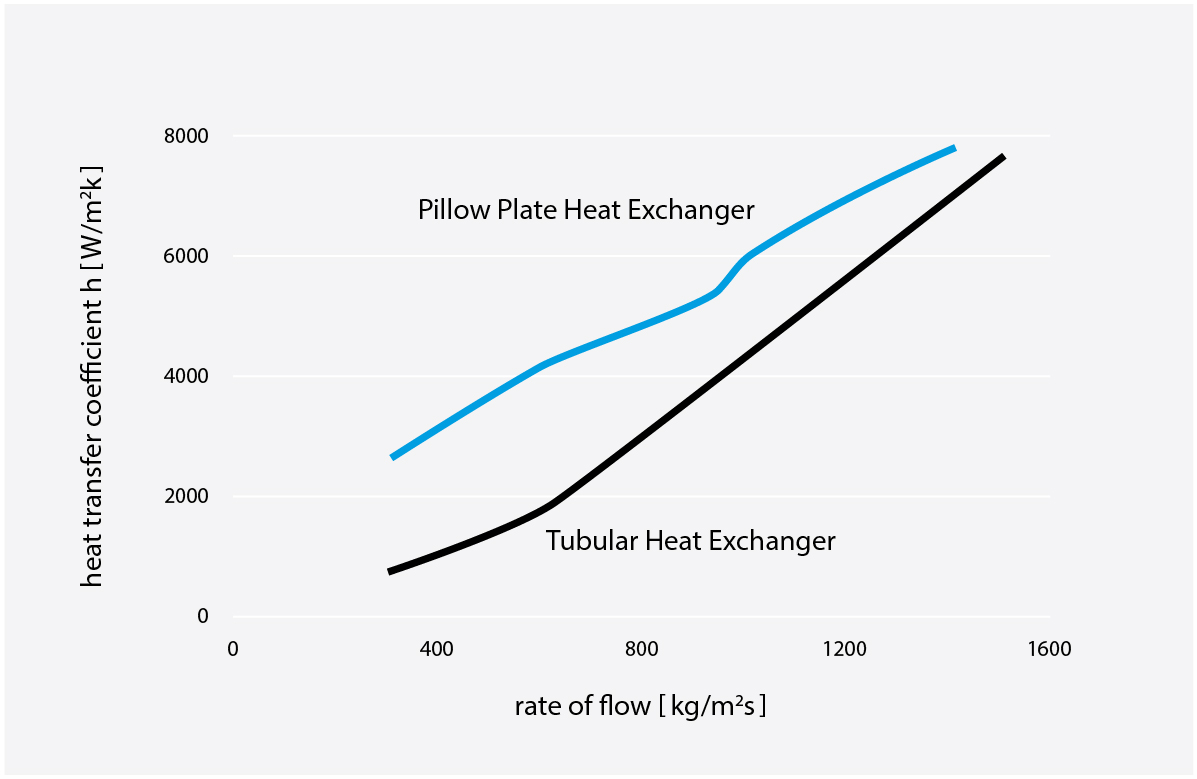
Pillow-plate constructions are excellent heat exchangers. Apart of a solid construction and taking up less space than ‘tubed’ box coolers, they also feature superior heat transfer properties. Due to their shape, turbulence is promoted, which in turn increases convection and therefore heat transfer. Relatively low power consumption means that UV-C lights can be active even when most of the ship’s engines are turned off. The coolers are made of the same material as the ship’s shea chest, avoiding in this way galvanic corrosion, which occurs when two dissimilar metals are electrically connected and immersed in the same electrolyte (like seawater). Sacrificial anodes (also in the scope of CORROSION) can be used to further eliminate corrosion risk.
Maintenance is less intensive as compared to copper-based antifouling systems. Without chemicals like copper, being released in the environment, UV-C protected pillow-plate constructions are also more friendly with the environment. All of this at an attractive cost of ownership.
 About the Author: Felipe Leon-Morales is an industrial microbiologist from the Javeriana University in Bogota, Colombia. Felipe holds a PhD in natural sciences from the University of Duisburg-Essen in Germany. After working on colloidal transport through biofilms and later on extremophile biofilms, Felipe focused on microbiologically influenced corrosion (MIC) while working for TNO in the Netherlands. In 2015 Felipe expanded his focus by joining the cathodic protection and antifouling company CORROSION, where he started the formation of a laboratory dedicated to corrosion and antifouling research







Contact us