 Exclusive Article
Victor Couto Alves

The New Corona Virus pandemic only opened up what has been talked about for a long time: we live in a Volatile, Uncertain, Complex and Ambiguous world! From one week to the next, and maybe, from one day to the next, everything can change, absolute truths are no longer so absolute, economic systems are put in check and new ways of thinking about society, working, managing companies, and even countries are discussed.
As Professor Marcos Cavalcanti, Coordinator of CRIE / UFRJ usually says “we need new glasses to see this new world”, after all: “Most organizations, whether companies, countries or institutions, die and people are obsolete not because they do things wrong, but because they keep doing the same thing for a long time” (Adapted from Yves Doz)
The watchword is ADAPTATION. Stop is no longer an option, it is necessary to continue following the life. Just like when riding a bicycle, we need to continue cycling if we don't want to fall. Thomas Friedman calls this "skill" "dynamic stability". In turn, Astro Teller, former CEO of Google X, says that 90% of the increase in human adaptability consists of optimizing learning. Paralleling to our personal and professional lives, it is nothing more than the famous Lifelong Learning or continuous learning.
In this context, Alvin Toffler, an American writer and futurist, has a famous phrase that has become a mantra in most texts and lectures that talk about the new education: “Illiterates in the 21st century will not be those who cannot read or write, but those who don't know how to learn, unlearn and relearn. ”
When I used this phrase for the first time it was much more for the impact it had than for knowledge of the cause or even understanding how it was actually applied in practice. Today, I realize that there are several research studies that can explain it and the purpose of this article is to give my view on it.
During my studies on the role of Personal Knowledge Management in continuous learning and professional success, I knew Connectivism, a theory of learning created by George Siemens and also developed by Stephen Downes to try to explain learning in this digital age.
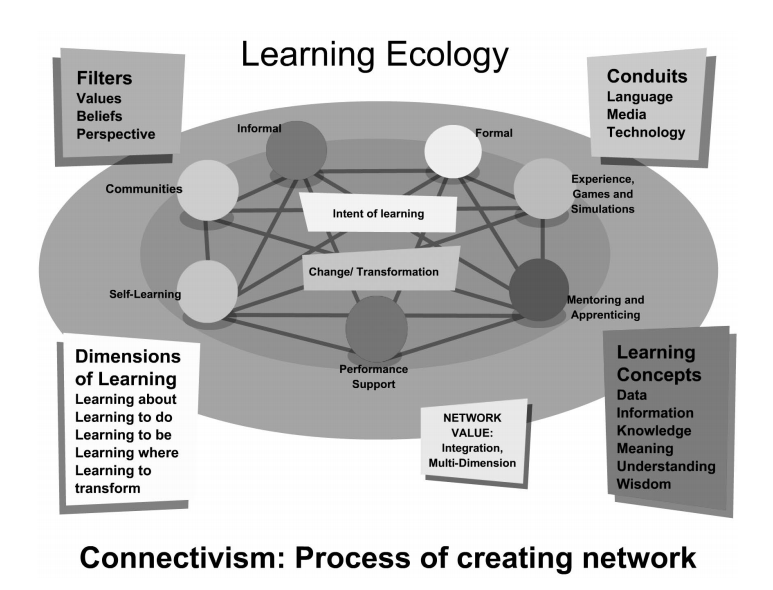
Source: Knowing Knowledge, Siemens (2006)
For Siemens (2006), learning goes far beyond the acquisition of knowledge. It is a process divided into several stages and its preparation involves exploration, decision making, selection and deselection, before the experience of learning and acquiring the knowledge itself. Siemens (2006), concludes that learning is a “process of creating networks” in which the nodes can be external, formed by people, organizations, websites, libraries, books, databases or any other source of information, and internal, when connections occur inside our minds. Learning Networks, therefore, can be perceived as external structures that are created in order to keep us updated and continuously be connected with new knowledge and experiences. And also as internal structures that are created and exist in our minds to connect and create patterns of understanding.
Similar to the concept proposed by George Siemens, Paul Jun, in his book “Connect the Dots”, says that learning is an act of connecting the dots. By reading, listening to interviews, lectures, podcasts, taking notes, building your knowledge base and putting knowledge into practice, whether you are writing about it or doing something, we are actually connecting dots, which in turn generate more connections and make us learn further. The more diverse these points are, the richer the learning will be. And each one has its own particular way of connecting their points, which contributes even more to the diversity of opinions, interpretations and views on the same subject for example.
Based on these assumptions, the act of learning, unlearning and relearning would be nothing more than the capacity we have to create, access and nurture the nodes and points of these networks when necessary, that is: the act of learning consists of accessing knowledge in electronic repositories and / or connections we have and also connect the points; to unlearn, it is important to be connected with a diversity of sources, which often oppose each other, which contributes to quickly change opinion or knowledge, if necessary, or you can also simply stop accessing knowledge or learning, and / or return it to a repository, or else not nurture pre-existing knowledge; and to relearn, it consists of re-accessing that knowledge base and / or connections and connecting a point again, when updating a text you wrote in the past or trying something again, for example.
That is why, nowadays, with the infinite connections that we can have, fake news being distributed without any critical analysis, and the life of knowledge so short, “knowing what” and “knowing how” already does not represent such a competitive advantage. What matters is knowing where to find this useful information and knowledge, at the right time when needed.
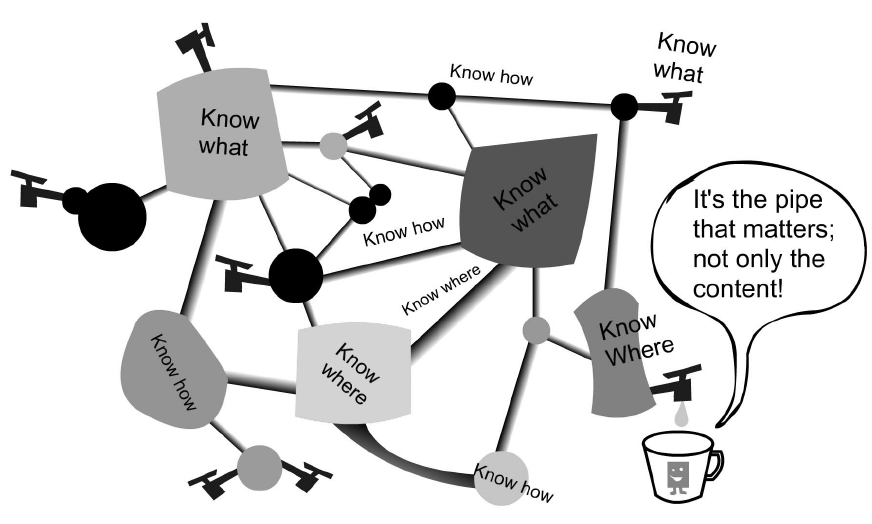
Source: Knowing Knowledge, Siemens (2006)
To systematize this approach, therefore, a model and / or structure that helps the individual in the identification and mapping of this knowledge and networks necessary for the development of the individual is necessary. In my view, Personal Knowledge Management and the Personal Business Model are the starting points for this. To understand how they work, I talk better about the first in this article and the second in this one (both in Portuguese).
About the author: Victor Couto Alves has a degree in Production Engineering and Technology in Oil and Gas, with a specialization in Knowledge Management from Coppe / UFRJ and Strategic People Management from HSM University. He has 10 years of experience in national and multinational companies in the oil and gas sector, having worked in the offshore operations, coordinating operations and contracts and currently works as a Knowledge Management Specialist at TechnipFMC. Outside the platforms and offices, he was and is active in the development of the oil and gas industry, where he was Coordinator of the IBP Youth Committee from 2013 to 2016 and since 2016 he is director of the SPE Brazil Section. In his free time, he seeks to serve the community as a volunteer in Social Projects related to education and career guidance, having created his pioneering career guidance blog, called TecnoPeG, in which he always sought to share knowledge and information about the industry.


Contact us