
 Economy
BloombergBusiness
Brazil’s energy industry is swimming in debt and renewable companies are leading the pack.
Renova Energia SA is at the top of a list of 15 power companies JPMorgan Chase & Co. ranked by debt levels, with leverage that’s 10.4 times earnings before interest, taxes, depreciation and amortization as of September. CPFL Energias Renovaveis SA came in third, with leverage of 5.9 times Ebitda, according to the report last month.
“Even for these companies that are like start ups and invested a lot in greenfield projects, the leverage levels are too high,” said Marcos Severine, an analyst at JPMorgan. “The leverage is worrying because it happens in a context that there is no liquidity or credit in the Brazilian market.”
JPMorgan estimated that Brazil’s energy companies had 87.2 billion reais ($21.9 billion) of obligations at the end of the third quarter. Their debt has increased in part because of Brazil’s 14.25 percent benchmark interest rate, the highest in almost a decade. With the government struggling to contain inflation and the country mired in the deepest two-year recession in more than a century, local credit markets have retrenched, making it harder for utilities to refinance.
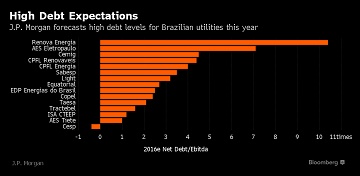
Renova is among the top renewable-asset owners in Brazil, according to Bloomberg New Energy Finance, with 327 megawatts of hydroelectric and wind plants operating across the country.
Energy Auctions
The company has been a big participant in Brazil’s energy auctions, where it has won long-term contracts to build 1.421 gigawatts of capacity through 2019, according to its website. Total debt increased 18 percent to 2.36 billion reais in September from 1.99 billion reais at the end of 2013.
The company is cutting costs and firing workers, and is also seeking to raise as much as 731 million reais by selling new shares. Cia. Energetica de Minas Gerais, which owns about 27 percent of the company, agreed to inject as much as 240 million reais in capital as part of a restructuring plan. A Renova press official didn’t respond to request for comment.
CPFL Renovaveis is Brazil’s largest renewable energy company, with 1.6 gigawatts of wind and hydroelectric assets, according to Bloomberg New Energy Finance. The company’s total debt was 6 billion reais in September, up 28 percent from a year earlier, according to its website.
CPFL Renovaveis will be able to handle its debt because it’s growing, said Andre Dorf, the company’s president. “We will generate more cash from projects that are starting operations,” he said in an interview in Sao Paulo. The company’s had 1.4 billion reais in cash in September, enough to cover debts maturing this year and last year.
Changing Trends
Renewable energy companies took advantage of declining interest rates before 2014, to increase leverage and invest massively in increasing capacity, according to Severine.
“Energy companies were surprised by trends changing in Brazil. They raised a lot of equity, won many power auctions and can improve their financial situation when more projects start operating,” he said. “But even like this, in the current scenario of tight liquidity, the relief would not be that great.”
The most attractive solution for utilities to de-leverage now is through equity offerings or asset sales, said Severine. The energy industry in Brazil would require a capitalization of 38 billion reais to curb indebtedness to a net debt that’s no more than 2 times Ebitda, “a comfortable leverage level,” he said.
“Now it is the time for private equity companies to look at renewable energy companies. The weak real favors capital injection by foreign partners and could encourage new foreign investors to enter the country,” said Severine.







Contact us