
 Joint Venture
Cosan Biomassa brings Brazilian born technology through the support of FINEP to tackle an international market worth over US$ 4 Billion
Press ReleaseCosan, one of Brazil´s largest energy and infrastructure group, and Sumitomo Corporation, one of the largest trading companies in Japan and beyond, have signed this Friday (02.26), at a ceremony at the Brazilian Embassy in Tokyo, an agreement to form a joint venture that will be the first company in the world to produce and commercialize biomass pellets made from sugarcane bagasse and straw. The deal is subject to regulatory approval by Brazilian and European antitrust authorities.
The innovative technology created by Cosan uses exclusively sugarcane residues to produce pellets that can substitute coal, natural gas and fuel oil in energy and heat generation. Cosan Biomassa, as the company is called, already has a production plant near Jau, Sao Paulo state interior, with a production capacity of 175 thousand tons of pellets per year. The production is expected to reach 2 million tons by 2025, and up to 8 million tons in the future, if confirmed the return expectations and the demand for this product. Cosan has 80% and Sumitomo has 20% of Cosan Biomassa.
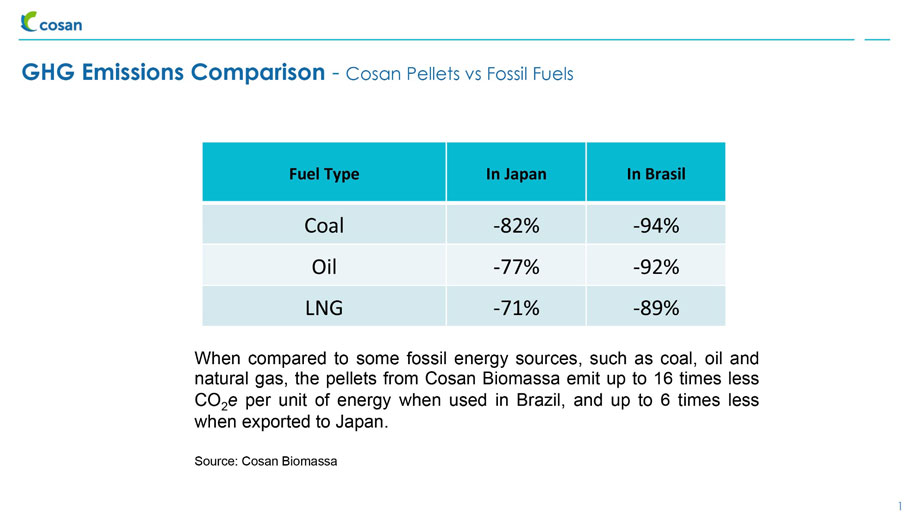
Many countries have already set targets for the use of renewable and sustainable energy generation, among them are Japan, South Korea and England. According to a study released by the European Commission earlier this year, the use of biomass in energy generation may be the cheapest way to reduce greenhouse gas (GHG) emissions. Current expectation is that over the next five years global demand for biomass pellets will jump from the 25 million tons commercialized today to approximately 40 million tons. Currently, the predominant raw material used to produce biomass pellets are forests planted in Europe, United States of America and Canada.
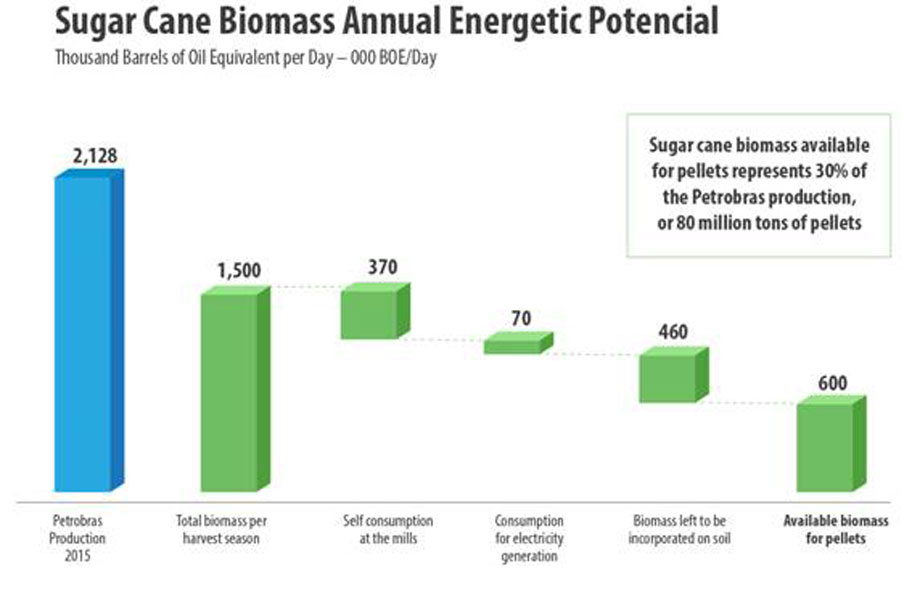
As global demand for biomass pellets increases, sugarcane has the potential to supply a growing share to the market. It is estimated that about 80 million tons of pellets could be produced by the sugarcane sector in Brazil. This potential is not explored today and could produce more than three times current global demand. It is said that there is a potential of 45million tons/year of sugarcane pellet from the sugarcane farm in Sao Paulo state alone.
“By the year 2030, we foresee that Japan will consume as much as 10million tons of pelletized biomass, or even more. Majority of which would come from overseas. Renewable energy including biomass will play a prominent role in our power generation sector by that time. We envisage that a relevant portion of this demand will be met by agricultural waste, particularly sugarcane biomass pellets produced in Brazil. Sugarcane’s productivity and abundant availability tied to the fact that we are using its residual byproduct as a raw material gives us an unique sustainability condition when compared to other biomass sources in the world”, said Yoshinobu Kusano, General Manager, Biomass Business, Sumitomo Corporation.
“By the year 2030, we foresee that Japan will consume as much as 10million tons of pelletized biomass, or even more.Majority of which would come from overseas. Renewable energy including biomass will play a prominent role in our power generation sector by that time. We envisage that a relevant portion of this demand will be met by agricultural waste, particularly sugarcane biomass pellets produced in Brazil. Sugarcane’s productivity and abundant availability tied to the fact that we are using its residual byproduct as a raw material gives us an unique sustainability condition when compared to other biomass sources in the world”, said Yoshinobu Kusano, General Manager, Biomass Business, Sumitomo Corporation.
The main target markets form Cosan Biomassa are Europe, Japan and South Korea which still rely on coal for about 30% of their electricity generation. In Brazil, where natural gas and fuel oil are still sold at high prices, biomass is also a competitive alternative and large industrial groups have already expressed interest.
“Brazil is already among the largest producers and exporters of agricultural commodities in the world. Pelletized biomass is a new commodity being created to serve the low carbon economy” said Mark Lyra, Cosan Biomassa CEO. “By making use of sugarcane residues and the growing concern about climate change in the world, Brazil is positioned to become the Saudi Arabia of renewable energy.” The company plans to make its first shipment to one of the major utilities in Europe later this year.
Joining forces with Sumitomo Corporation, one of the largest biomass trading organizations in the world, drives at creating a new market focused on new sustainable energy sources. Last year, the United States of America and Canada exported over 6 million tons of biomass pellets to Europe and Asia while the remaining demand was met by local production. The USA government is evaluating the possibility of using biomass to reduce their dependence on coal. If this is the case, a simple 5% shift of coal to biomass in energy generation means the USA market could switch from exporter to importer of biomass within a short time span since this would mean that 28 million tons of additional volume would need to be produced to meet demand. With the growing demand in Europe and Asia alone the market will need 15 million tons for additional production by 2030 and the largest untapped biomass resource in the world is found in Brazil´s sugarcane sector.







Contact us