
 Environment
T&B Petroleum/Press Office

Flying in an airplane is among the worst things you can do for your carbon footprint, and sustainable jet fuels are an essential part of making aviation more climate-friendly. A new Swiss research initiative is investigating ways to produce fuel from renewable resources, but scaling up will be a challenge.
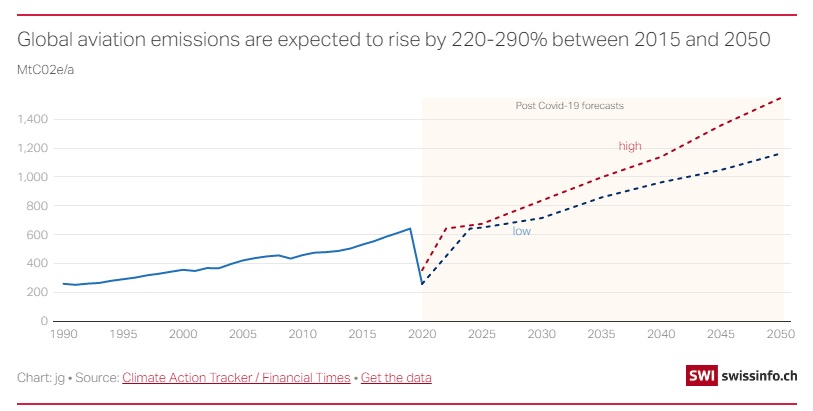
Today, airplanes account for 2-3% of global carbon dioxide (CO2) emissions, but their share has been growing rapidly and is expected to triple by 2050 as demand for flights – both passenger and freight - increases around the world.
Experts agree that there is no silver bullet to help aviation become greener and that a series of measures will have to be implemented in the coming decades. These include more fuel-efficient aircraft designs and electric planes.
But the best medium-term solution for transforming aviation’s carbon footprint may lie in sustainable aviation fuels (SAFs), which first appeared in 2008. They produce up to 80% fewer carbon emissions than conventional jet fuel and are made from biomass (plants or waste) or recycled carbon.
Today they are expensive and are only being used in limited quantities by some airlines, blended with regular fuel. But the International Air Transport Association (IATA), the airline industry’s umbrella organisation, wants to massively increase the use of SAFs by 2025. The plan requires greater buy-in from airlines, industry, governments and scientists who must find ways to make more, and cheaper, sustainable fuels.
Alert to this challenge, the Paul Scherrer Institute (PSI) and the Swiss Federal Laboratories for Materials Science and Technology (Empa) launched a joint CHF6.2 million ($6.5 million) “Synfuels” research initiativeExternal link in January aimed at identifying the best ways of producing green aviation fuel.
“Drop-in sustainable fuels [jet fuels that can be put in aircraft tanks without having to make changes to the aircraft] are the ideal transitional pathway,” PSI researcher Peter Jansohn told SWI swissinfo.ch. “They will make a considerable contribution to reducing CO2 emissions from aviation.”
His colleague Björn Niesen at Empa agrees.
“Alternative airplane propulsion systems like hydrogen and batteries, which are still far too heavy for long-distance flights, will take a long time to work out and certify. So, we really need to have a drop-in solution like sustainable aviation fuels. There is no other fast alternative,” he says.
How will it be done?
Over the next three years, PSI/Empa scientists will examine and compare various techniques used to make SAFs – both well-known and more unusual - with a view to creating pilot production plants.
Several production pathways already exist for such fuels. The processes involve getting carbon dioxide and hydrogen from renewable sources and then combining them to form longer-chain molecules.
Carbon dioxide can come from various sources, such as the atmosphere or from industrial manufacturing processes like cement production. Hydrogen is generated from water with the help of renewable electricity.
Making a liquid jet fuel from renewable sources can involve different methods and one or more intermediary stages, such as first producing carbon monoxide, methanol, ethylene, or dimethyl ether, say the Swiss scientists.
“The synthesis route via methanol and dimethyl ether is more established. Empa is looking at the production process that is less established based on ethylene,” says Niesen.
The ethylene route is less researched and is more uncertain from a technical perspective, but it allows a simpler path to the end product, say the scientists.
Biomass
The jet biofuels currently approved for use are made via an established technique that involves taking a hydrocarbon from biomass - waste, vegetable oil, algae or sugarcane, for example - and breaking it up with a thermal process into carbon monoxide and hydrogen. These are converted via the so-called Fischer-Tropsch process - a collection of chemical reactions- into liquid hydrocarbons.
“The disadvantage with the Fischer-Tropsch synthesis route is that you cannot always direct this synthesis process exactly,” says Jansohn. “You always get a spectrum of hydrocarbons and you need to do a final refining process to pick out the ones which really resemble jet fuel quality.”
Sustainable aviation fuels have their critics, such as Greenpeace. The environmental advocacy organisation maintains that jet biofuels from biomass are a “false solution for the climate”. They argue that using crops for biofuels risks putting more pressure on the fragile ecosystem and that people should simply fly less.
Alternative pathways
Jansohn agrees that limited biomass resources means it is essential to “tap into other carbon resources” to ensure enough SAF can be produced in the future. Recycling and re-using CO2 from various sources such as industrial processes or the atmosphere will be essential, he says.
But the creation of such alternative synthetic fuels, aka power-to-liquid fuels or e-fuels, from recycled or directly-captured CO2 and low-carbon electricity is not a straightforward process either. Synthetic fuels require lots of renewable electricity to produce, making them very expensive. They also have a carbon footprint, something the PSI/Empa team will be studying.
The PSI/Empa initiative is not the only SAF project in Switzerland looking into alternative production methods. Last year it was announced that the Lufthansa Group had entered a partnership with the Swiss solar fuel developer Synhelion, a Swiss start-up originating from ETH Zurich, which uses a technique that produces carbon-neutral fuels from sunlight and air.
Massive opportunity, massive challenge
The aviation industry has high hopes for SAFs. As the world’s leading airlines consider an ambitious pledge for net-zero carbon emissions by 2050External link, SAFs are “perhaps the single largest opportunity to meet and go beyond” that goal, according to the cross-industry Air Transport Action Group (ATAG) in its Waypoint 2050 documentExternal link published last September.
Scaling up production is a huge challenge. ATAG says the industry will likely need 450-500 million tonnes of SAFs per year by 2050; current production stands at 64,000 tonnes per year..
But the task is “far from insurmountable”, it says. More production can be achieved via “rigorous sustainability criteria” and by diversifying production to use a “range of feedstocks from non-food crops to waste sources and eventually a shift to power-to-liquid fuels made from recycled or directly captured CO2 and low-carbon electricity”,” ATAG’s assessment concluded.
Government policy, targets and investment will play a critical role, alongside pressure and demand from consumers willing to pay more for greener flights, and cross-sector efforts. Last September Switzerland’s parliament approved a carbon tax on airline tickets, part of which will go towards a “climate fund” and the production of sustainable fuels.
Binding measures needed
In Europe, Brussels is drawing up targets for airlines to use a minimum share of SAFs. So far their uptake has been hit by high costs and weak demand from airlines, which have traditionally opposed mandated quotas. SAFs are over twice as expensive as conventional jet fuel, and airline profits took a massive hit amid the Covid-19 pandemic, making investment in alternative fuels more difficult in the short-term.
Meanwhile, some aircraft manufacturers such as Airbus and Boeing have plans of their own. Boeing says it will begin delivering commercial airplanes capable of flying on 100% biofuel by the end of the decade.
Jansohn of the Paul Scherrer Institute says that binding commitments from the aviation industry to continually increase the use of carbon-neutral aviation fuel will be essential. “At the moment there are only voluntary commitments for such a reduction path,” he says.
The PSI/Empa teams say various stakeholders have shown interest in their project, including the Swiss Federal Office of Civil Aviation and the Department of Defence. But no commercial partners or aviation companies are presently involved.
“We are not that far with the technology and development to scale it up to a size where we can produce large amounts of fuel,” says Niesen. “The idea is to really prepare up to the stage when we can talk to industrial partners to establish pilot plants and systems.”






Contact us