
 Technical Article
ABS Group

By Christiane Machado
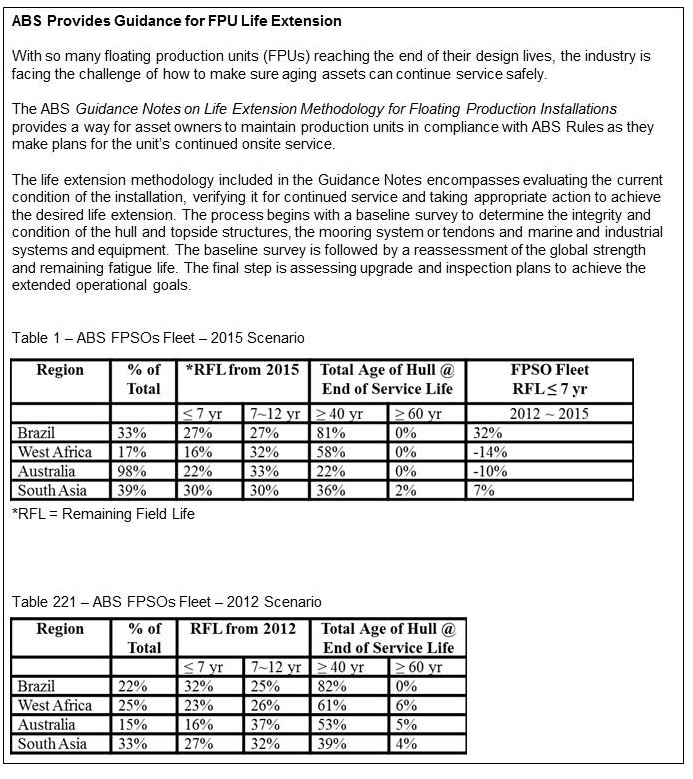
The increasing demand for floating production, storage, and offloading (FPSO) units over the last two decades led to the conversion of a large number of trading tankers and a significant number of newbuilds. Those units were delivered with an anticipated service life that is now coming to its end. In fact, nearly one-fifth of the worldwide FPSO fleet is approaching the end of its intended service life, and a large number of these units are working offshore Brazil.
With field delineation programs that have brought new fields online along with extensive recoverable reserves, there is a need for many of the aging units to continue working beyond what was originally anticipated. There clearly is an industry need to extend the service lives of existing FPSOs, but for continued service to be achieved safely, owners and operators have to take a systematic approach to evaluating asset integrity and determining how these aging units must be modified or enhanced to continue producing.
Picking up the Aging Asset Challenge
Classification societies follow industry trends and develop and expand Rules and Guides so that they keep pace with industry needs. A case in point is ABS’ recently released Guidance Notes on Life Extension Methodology for Floating Production Installations (FPIs). The goal is to provide a process of verifying the adequacy of an FPSO to withstand the design operational loads and to make sure updates and refurbishments will accommodate current requirements and any additional equipment needed onboard.
The ABS Brazil Offshore Technology Center has devoted considerable effort to staying abreast of changing demands for units operating offshore Brazil and has developed a new methodology to review these units. This process applies the existing codes and Class Rule requirements and currently available engineering tools for numerical simulations along with a new methodology to review these units employing technology tools developed using studies comparing existing FPSO arrangements based on prescriptive classification rule requirements and finite element analyses.
The engineering team compared the results of these analyses with the original approved design data to get a better understanding of the unit’s structural capacity at the conversion stage and its performance during its intended service. This information was used to determine the length of time service life could be extended. The resulting methodology allows engineers to assess FPSOs to determine the unit’s remaining structural life.
Creating a Method for Determining Remaining Fatigue Life
Multiple issues need to be addressed when evaluating an FPSO for life extension. Typically, these types of units remain on location throughout their service lives, which means they have not undergone dry docking. Over time, loads on production units can increase due to changing environmental conditions or weight growth from marine life. And changes in regulatory requirements can change performance expectations significantly.
Because of the critical number of concerns, there was a clear need for an approach that goes beyond usual structural inspections. The ABS solution employs an in-service inspection program that delivers the information necessary to determine structural degradation over the years of operation, identify previous repairs and define the current condition of the unit.
FPSOs function as storage units, so they are designed with multiple tanks that are dedicated to cargo storage. The presence of tanks necessitates additional cleaning requirements as well as inspections, which directly affect the daily production and storage activities. Life extension studies focused on detailing a methodology for fatigue analysis – including wastage conditions and corrosion rates – with the goal of defining the survey scope in a way that allows for precise mitigation actions to be put in force to reduce the number of inspections needed without compromising safety.
With this objective in mind, the engineering team began looking for a way to optimize application of current Rules, focusing on maintaining Rule safety margins to reduce the number of tank inspections. In the end, it became apparent that these conditions could be achieved by performing verification of prescriptive rule requirements for original and modified design input data. The information gathered could then be used to develop a numerical simulation of past and future hull structural behavior that could be used to determine future service capability. These studies provided a comprehensive understanding of structural conditions that could lead to a reduction in structural interventions.
By refining the engineering effort, the team was able to identify critical areas and to pinpoint connections of hull, mooring supports and topside supports that need to be evaluated for fatigue and wear so the unit could continue to be used safely on site.
The Thinking Behind the Method
To set up the study, the team selected three FPSOs – converted from tankers – that had been in operation for more than 15 years and evaluated their structural characteristics according to the current FPI Rules for design input data at the time of conversion.
Data required for each of the three units included:
• Environmental data, such as significant wave height and annual wave scatter diagram;
• Critical Damping of FPSOs;
• Vessel displacement, center of gravity, metacentric height in meters (GM), and radii of gyration in all directions;
• Hull gauging.
The information was used to determine the current condition of the units and to determine compliance with current requirements. Using this information, the team was able to identify the extent of verification that would be needed for each vessel in order to get a complete understanding of the unit’s behavior at sea. The goal was to identify the investigations needed to determine the least amount of renewal and fewest inspections required to achieve compliance during the expected remaining service life in the field.
For this study, the FPI Rule requirements were divided into two sections: one covering prescriptive requirements and the other covering methodology for structural evaluation using finite element analysis (FEA). The idea was to investigate both prescriptive and FEA to provide a consistent overview of applicability of current rules to mature FPSOs.
The team found that it is feasible to use current Rules to evaluate the integrity of FPSOs designed 20 years ago, but it is important to pay particular attention to some aspects of the Rules in re-evaluating older units. For example, design parameters for loading conditions and site-specific environmental data scatter diagrams should be updated and considered in the Life Extension Reassessment Study because they are crucial for the investigations of current prescriptive and structural evaluation rule requirements. Because input data on historical routes and historical specific sites affect strength and fatigue environmental severity factors, they should be analyzed carefully at the early stage of the life extension engineering assessment. Finally, there are some inspections that add significant value to the process. For instance, it might be worthwhile to perform initial scantling evaluations for several cargo tank bays instead of performing a midship tank inspection and extrapolating the results to the cargo tanks.
The Next Steps Forward
As the industry looks toward the next 50 years of operations, stakeholders are taking stock of aging assets. This investigation allowed ABS to make strides toward more effective and efficient life-extension evaluations, but there are opportunities for further research and development studies that could enhance the proposed FPSO life extension methodology.
By spearheading life extension initiatives and conducting studies and analyses for deepwater production units, ABS is setting a precedent for life extension of floating offshore facilities offshore Brazil and elsewhere.

Christiane Machado is the Manager of Brazil Offshore Technology Center of ABS (BOTC), under the Corporate Division. She joined ABS as a senior engineer in the Rio de Janeiro office in 2006 and was involved in ABS review of several novel concepts reviews in Brazil and abroad before being transferred to establish and lead the BOTC, in 2010.
Machado has more than twenty years of experience as a naval architect, focusing on structural basic and detailed design for ships and offshore structures and has been involved in numerical simulations of several FPSOs to address behavior at sea, vibration, strength, fatigue, and reliability.
She holds a Master in Science degree in Ocean Engineering from Rio de Janeiro Federal University and is a member of several professional associations, such as the Society of Naval Architects and Marine Engineers (SNAME), the American Society of Mechanical Engineers (ASME), and the Brazilian Society of Naval Architects (SOBENA).










Contact us
2